
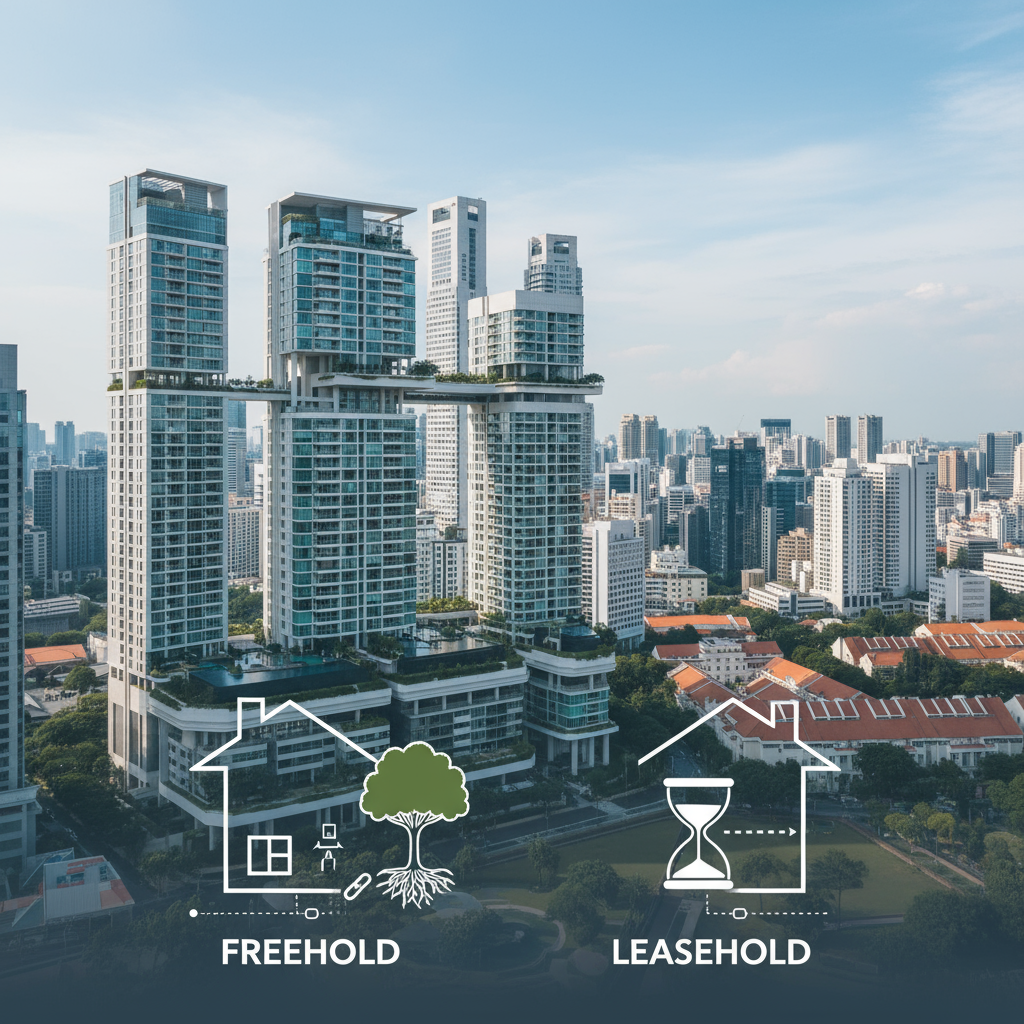
Freehold vs Leasehold: Understanding Property Ownership in Singapore
Buying property in Singapore is a significant decision. It involves a substantial financial commitment. One of the most important aspects to understand is the difference between freehold and leasehold property. This distinction affects property value, financing options, and long-term investment potential. For Singapore property buyers, sellers, and real estate professionals, a clear grasp of these concepts is essential. This article explains freehold and leasehold ownership, using Singapore-specific examples and regulations.
In Singapore, property ownership is primarily divided into these two categories. Freehold ownership means you own the land and the building on it indefinitely. There is no time limit. Leasehold ownership, however, means you own the property for a specific period. This period is typically 99 years or 999 years. The Singapore government is the largest landowner. Most residential properties are leasehold. Understanding which type of ownership suits your needs is crucial. It impacts resale value, inheritance, and future development potential. We will explore these differences in detail. This will help you make informed property decisions in Singapore.
What is Freehold Property in Singapore?
Freehold property in Singapore offers permanent ownership. When you buy a freehold property, you own the land and any structures on it forever. There is no expiry date. This type of ownership is often seen as more desirable. It provides a sense of security and permanence. Many buyers prefer freehold properties for their long-term value.
Key Characteristics of Freehold Property:
* Permanent Ownership: The owner holds the title to the land and property indefinitely.
* No Lease Expiry: Unlike leasehold, there is no need to worry about the lease running out.
* Inheritance: Freehold properties can be passed down through generations without time limits.
* Scarcity: Freehold land is limited in Singapore. This makes freehold properties rarer and often more expensive.
* Value Retention: Freehold properties often retain their value well over time. They may even appreciate more steadily compared to leasehold properties, especially as leasehold terms shorten.
Singapore Examples of Freehold Properties:
Many older condominiums and landed houses in prime districts are freehold. For example, properties in areas like District 9 (Orchard, River Valley), District 10 (Holland Road, Bukit Timah), and District 11 (Newton, Novena) often include a good number of freehold developments.
Consider a family who bought a freehold landed house in Bukit Timah in 1980. Today, that property is still fully owned by the family. They can pass it to their children. There is no concern about the land lease expiring. This provides long-term stability. This contrasts sharply with a leasehold property that would have a remaining lease of about 55 years by now.
Another example is The Marq on Paterson Hill. This condominium is a freehold development. Its units command high prices due to its prime location and freehold status. Buyers pay a premium for the perpetual ownership. This shows the market’s perception of freehold value.
Regulations for Freehold Property:
While freehold property offers permanent ownership, it is still subject to Singapore’s land use planning rules. The Urban Redevelopment Authority (URA) controls land use. Even freehold owners must follow zoning regulations. They cannot build whatever they want without approval. For instance, a freehold landed property zoned for two-storey housing cannot be redeveloped into a skyscraper. This ensures orderly urban development.
Singapore’s land sales programme primarily releases leasehold parcels. This makes existing freehold land more valuable due to its scarcity. This scarcity contributes to the higher price of freehold properties.
What is Leasehold Property in Singapore?
Leasehold property means you own the property for a specific period. This period is typically 99 years or 999 years. The land itself belongs to the government or a private developer. When the lease expires, the land reverts to the owner. Most properties in Singapore are leasehold. This includes Housing Development Board (HDB) flats, Executive Condominiums (ECs), and many private condominiums.
Key Characteristics of Leasehold Property:
* Fixed Term Ownership: Ownership lasts for a set duration, usually 99 or 999 years.
* Lease Decay: The value of a leasehold property tends to decrease as the lease shortens. This is especially true when the remaining lease falls below 60 years.
* Government Dominance: The Singapore government owns most of the land and releases it on a leasehold basis.
* Affordability: Leasehold properties are generally more affordable than comparable freehold properties. This makes them accessible to a wider range of buyers.
* En Bloc Potential: Older leasehold properties may have en bloc (collective sale) potential if their lease is running down. Developers might buy them for redevelopment.
Singapore Examples of Leasehold Properties:
Most HDB flats are 99-year leasehold. For example, a 99-year lease HDB flat bought in 2000 will have its lease expire in 2099. The owner enjoys the property for that period. After 2099, the flat returns to the HDB.
Private condominiums like Reflections at Keppel Bay are also 99-year leasehold. Despite their luxurious nature, they have a finite ownership period. The initial lease for such developments typically starts from the date the government sells the land to the developer.
A real-world example: A 99-year leasehold condominium in Bishan, built in the 1980s, now has about 60 years remaining on its lease. When owners try to sell these units, buyers and banks consider the remaining lease. Banks may offer lower loan quantum or shorter loan tenures for properties with shorter leases. This affects the property’s market value.
Regulations for Leasehold Property:
The terms of the lease are binding. They include conditions on land use, maintenance, and permitted alterations. For HDB flats, owners must follow HDB rules. For private leasehold properties, owners must follow the developer’s lease terms and the URA’s planning guidelines.
The “lease decay” phenomenon is a major factor for leasehold properties. As the lease shortens, the property’s value often decreases. This is because the economic life of the asset is diminishing. The government has policies like the Selective En bloc Redevelopment Scheme (SERS) for HDB flats. SERS helps older HDB estates renew. It offers compensation and new flats to affected residents. However, SERS is not guaranteed for all old HDB flats.
99-Year Leasehold vs. 999-Year Leasehold
Within leasehold properties, there is a distinction between 99-year and 999-year leases. This difference is significant for buyers.
99-Year Leasehold:
* Common: This is the most common type of leasehold in Singapore for both HDB and private properties.
* Government Standard: The government typically sells land on a 99-year lease. This policy helps manage land scarcity and allows for future urban planning.
* Lease Decay Impact: The impact of lease decay is more pronounced with 99-year leases. As the lease approaches expiry, property values decline more significantly.
* Financing: Banks are more cautious about lending for properties with less than 60 years remaining on the lease. This can make it harder to sell or refinance.
999-Year Leasehold:
* Historical Legacy: Most 999-year leases originate from colonial times. The British Crown granted these long leases.
* Near-Freehold: For practical purposes, a 999-year lease is often considered almost equivalent to freehold. The expiry date is so far in the future that it has minimal impact on value or ownership concerns.
* Scarcity: Like freehold properties, 999-year leasehold properties are rare. This rarity contributes to their higher value.
* Value Retention: These properties tend to hold their value very well. They experience minimal lease decay compared to 99-year leases.
* Examples: Some older private condominiums and landed properties, particularly in established districts, might be 999-year leasehold. For instance, some shophouses in conservation areas have 999-year leases.
A case study: Consider two identical condominiums, one with a 99-year lease and one with a 999-year lease, both built in 1990. The 99-year lease property will have a remaining lease of about 66 years today. Its value will be affected by lease decay. The 999-year lease property, however, will have a remaining lease of about 966 years. Its value will not be significantly affected by the lease term. This demonstrates why 999-year leasehold properties often command prices similar to freehold properties.
Investment Considerations: Freehold vs. Leasehold
When investing in Singapore property, the choice between freehold and leasehold has major implications. Investors must weigh the pros and cons carefully.
Freehold Investment Pros:
* Long-Term Appreciation: Freehold properties often have stronger long-term capital appreciation potential. This is because of their permanent nature and scarcity.
* Estate Planning: They are excellent for inter-generational wealth transfer. There is no lease expiry concern.
* Lower Risk of Lease Decay: The value is not eroded by a diminishing lease term.
Freehold Investment Cons:
* Higher Entry Price: Freehold properties are usually more expensive per square foot. This means a higher initial capital outlay.
* Lower Rental Yield: The higher purchase price can sometimes lead to lower rental yields compared to leasehold properties in similar locations.
* Limited Supply: Finding a suitable freehold property can be challenging due to scarce supply.
Leasehold Investment Pros:
* Affordability: Leasehold properties are generally more affordable. This allows investors to buy into prime locations with a lower budget.
* Higher Rental Yields: Due to lower capital outlay, leasehold properties can offer better rental yields, especially newer ones.
* More Options: The majority of new developments are leasehold. This provides more choices for buyers.
* En Bloc Potential (for older properties): Older leasehold properties nearing the end of their lease might be attractive for collective sales. This can provide a windfall for owners if successful.
Leasehold Investment Cons:
* Lease Decay: The biggest drawback is the depreciation in value as the lease shortens. This affects resale value and financing options.
* Finite Ownership: Ownership is not permanent. The property reverts to the landowner when the lease expires.
* Financing Challenges: Properties with very short remaining leases (e.g., less than 60 years) can be difficult to finance. This limits the pool of potential buyers.
Practical Investment Advice:
For example, a property investor bought a 99-year leasehold condominium when it was new (e.g., in 2010 with a full 99-year lease). They plan to sell it after 10-15 years. By then, the remaining lease will still be substantial (84-89 years). The impact of lease decay will be minimal. The property may have appreciated due to overall market growth and development in the area. This approach capitalises on the initial appreciation phase of new leasehold properties.
Buying and Selling: Impact on Financing and Resale
The type of property ownership significantly impacts buying and selling processes, particularly regarding financing and resale value.
Impact on Financing:
* Freehold and 999-Year Leasehold: Banks generally have no issues providing loans for these properties. The loan tenure can extend up to 30-35 years, or until the borrower’s age of 65-75, whichever is earlier.
* 99-Year Leasehold:
* Newer Properties (80+ years remaining lease): Banks offer standard loan packages. Loan tenures are similar to freehold properties.
* Older Properties (60-80 years remaining lease): Banks may become more cautious. They might offer a shorter loan tenure. For example, if a property has 70 years left, the bank might cap the loan tenure at 30 years, or even less, depending on their internal policies.
* Very Old Properties (Less than 60 years remaining lease): This is where financing becomes challenging. Some banks may refuse to lend altogether. Others might offer a much shorter loan tenure, potentially requiring a larger down payment from the buyer. The Central Provident Fund (CPF) usage for properties with less than 60 years lease is also restricted. The amount of CPF usable depends on whether the remaining lease can cover the youngest buyer up to age 95. If it cannot, the CPF withdrawal limit is prorated.
Case Study: A buyer wants to purchase a 99-year leasehold HDB flat with 55 years remaining on its lease. The buyer is 40 years old. Under current CPF rules, the CPF usage will be restricted. The bank will also likely offer a shorter loan tenure, perhaps only 15-20 years, instead of the standard 30 years. This means higher monthly mortgage payments, making the property less affordable for many buyers.
Impact on Resale Value:
* Freehold: These properties often command a premium. Their value tends to be more stable and can appreciate well over long periods, especially in prime locations. The absence of lease expiry removes a major concern for buyers.
* 999-Year Leasehold: Similar to freehold, these properties maintain strong resale values. The very long lease term makes them attractive.
* 99-Year Leasehold:
* Newer Properties: They generally hold value well in their initial decades. They can even see significant appreciation, especially if located in developing areas.
* Mid-Life Properties (40-60 years old): This is where lease decay starts to become a more noticeable factor. Resale values might stagnate or even decline slightly compared to newer properties. Buyers become more mindful of the remaining lease.
* Older Properties (60+ years old with short remaining lease): These properties face the most significant challenges. Their value is heavily impacted by the short lease. The pool of potential buyers shrinks due to financing difficulties.
Practical Tip for Sellers: If you own an older leasehold property, consider selling it before the remaining lease becomes too short (e.g., before it drops below 65-70 years). This maximises your chances of getting a good price and finding a buyer who can secure financing easily.
For real estate professionals, understanding these nuances is critical. You must advise clients accurately on the implications of freehold vs. leasehold. This includes explaining potential financing hurdles and future resale prospects. A buyer looking for a long-term family home might prefer freehold. An investor seeking higher rental yields might consider a newer 99-year leasehold property. Each choice has specific benefits and drawbacks.
By clearly understanding freehold and leasehold properties, Singapore buyers, sellers, and professionals can make better decisions. This knowledge helps in evaluating property values, planning finances, and strategising for future property transactions.
Ready to Take the Next Step?
WhatsApp us to enquire about your property and get expert guidance to your needs.