
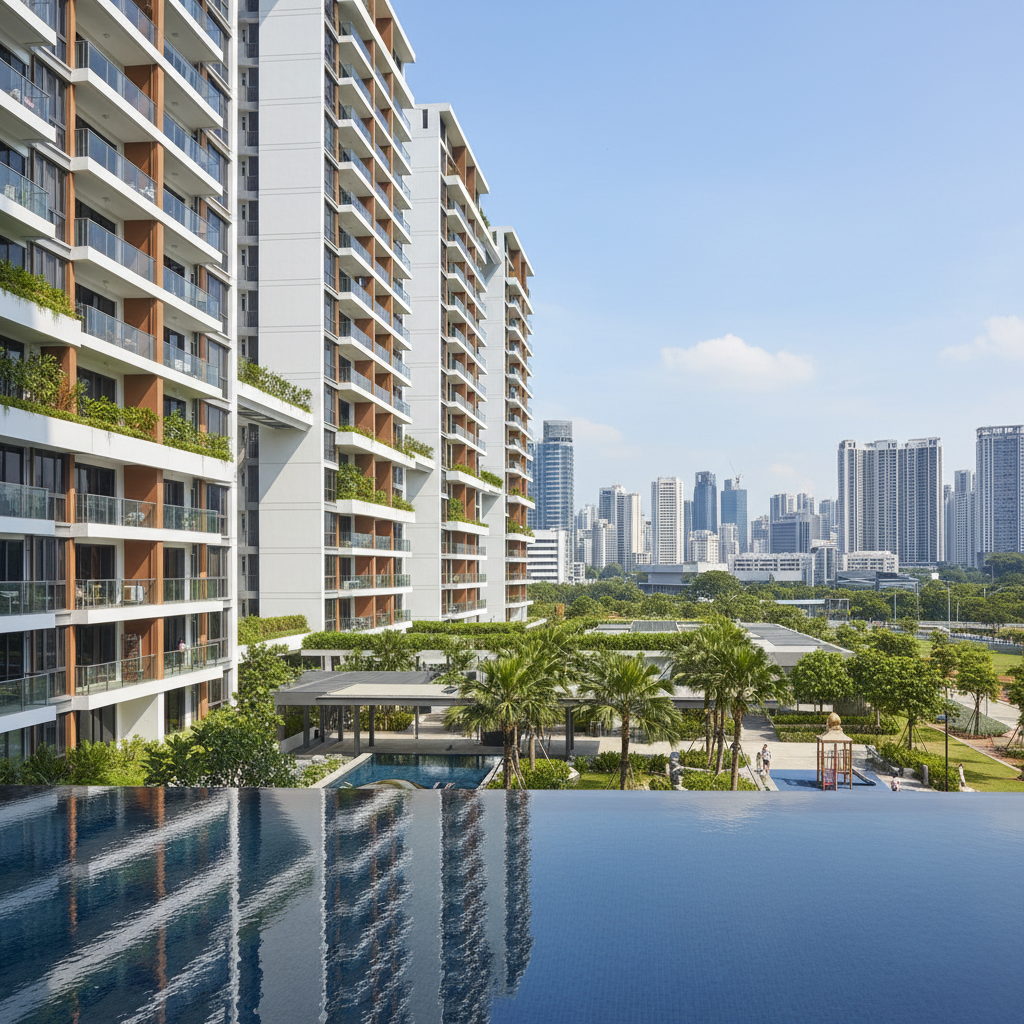
# EC Criteria: A Guide to Executive Condominiums in Singapore
Executive Condominiums (ECs) represent a unique housing option within Singapore’s property landscape. These hybrid properties combine the features of public housing with the amenities of private condominiums. They cater specifically to a group of Singaporean households whose income exceeds the ceiling for HDB (Housing & Development Board) flats but who may find private condominiums financially out of reach. Understanding EC criteria is crucial for anyone considering this pathway to homeownership. This guide explains the rules for buying, owning, and selling ECs, offering clear insights into who qualifies and what processes are involved. We aim to demystify ECs, making them more accessible for potential buyers, current owners, and real estate professionals alike. Knowing these criteria helps buyers make informed decisions and ensures sellers can market their ECs effectively.
## Understanding Executive Condominiums
Executive Condominiums bridge the gap between public housing and private properties in Singapore. They are developed and sold by private developers but come with certain restrictions during their initial years, similar to HDB flats. These properties offer condominium-style facilities such as swimming pools, gyms, and security. However, they are generally more affordable than private condominiums due to government subsidies and land sale conditions. The purpose of ECs is to provide good quality, affordable private-style housing for Singaporean citizens in the “sandwich class.” This group earns too much for HDB flats but might struggle with the price tag of full private condominiums. The government introduced ECs in 1999 to meet this specific housing need.
The main difference between an EC and a private condominium lies in their eligibility criteria and ownership rules for the first ten years. For example, buyers of new ECs must meet HDB’s eligibility conditions, including income ceilings and family nucleus requirements. After the first five years, known as the Minimum Occupation Period (MOP), ECs can be sold only to Singapore citizens and Permanent Residents (PRs). After ten years, all ownership restrictions are lifted, and an EC is considered fully privatised, meaning it can be sold to foreigners as well. This staged liberalisation of ownership is a key characteristic of the EC scheme.
Consider the recent launch of a development like Penrith in Queenstown. While Penrith is a private condominium, the demand for such new units highlights the ongoing need for housing in mature estates. ECs, though governed by different rules, also contribute significantly to Singapore’s diverse housing supply. They offer a stepping stone for many families to upgrade their living standards while remaining within a manageable budget. Understanding their unique position within the property market helps homeowners plan their financial journey.
## Eligibility Criteria for Buying New ECs
Buying a new Executive Condominium directly from a developer involves strict eligibility criteria set by the HDB. These rules ensure that ECs serve their intended purpose: providing affordable private-style housing to eligible Singaporean families. Potential buyers must meet all conditions before they can apply for a new EC. Failing to meet even one criterion will disqualify an applicant.
The primary eligibility conditions include:
* **Citizenship:** At least one applicant must be a Singapore Citizen. If there is only one Singapore Citizen, the other co-applicant must be a Singapore Permanent Resident. All applicants must be at least 21 years old.
* **Family Nucleus:** Applicants must form a valid family nucleus under one of the HDB schemes. Common schemes include:
* Public Scheme (married couple or intending to marry)
* Fiancé/Fiancée Scheme
* Orphans Scheme
* Joint Singles Scheme (two Singapore Citizens age 35 or older)
* **Income Ceiling:** The total monthly household income must not exceed S$16,000. This ceiling is reviewed periodically by the government. This specific income limit ensures that ECs remain accessible to higher-income HDB upgraders and first-time buyers who do not qualify for BTO flats.
* **Property Ownership:** Applicants cannot own any other property (HDB flat, private property in Singapore or overseas) at the time of the EC application and within 30 months before the application. If they do own property, they must dispose of it within six months of collecting the keys to the EC.
* **Resale Levy:** Buyers who have previously purchased a HDB flat or received a CPF housing grant for a subsidised flat may be subject to a resale levy. This levy is a payment to the HDB when buying another subsidised housing unit. The amount depends on the type of previous HDB flat.
Let’s look at an example. A young Singaporean couple, both citizens, aged 30 and 31 respectively, with a combined monthly income of S$15,000, wants to buy their first home. They do not own any other property. They meet the citizenship, family nucleus, and income requirements. They can apply for a new EC. However, if their income was S$17,000, they would be ineligible for a new EC and would need to consider resale ECs (after their MOP) or private condominiums. These guidelines ensure fairness and target those who truly need and qualify for a subsidised private-like home.
## Minimum Occupation Period (MOP) and Resale Restrictions
The Minimum Occupation Period (MOP) is a critical concept for Executive Condominiums, just as it is for HDB flats. The MOP for an EC is **five years**, starting from the date of key collection. During this five-year period, owners must physically occupy the EC unit. They are not allowed to rent out the entire unit, nor can they sell it on the open market. This rule is in place to prevent speculative buying and ensure ECs fulfil their primary purpose of providing homes for eligible families.
Once the MOP is fulfilled, EC owners gain more flexibility. However, there are still specific restrictions that apply to foreign ownership and other aspects. Here is a breakdown:
* **Years 1-5 (During MOP):**
* Owners must live in the unit.
* No rental of entire unit allowed.
* No sale on the open market.
* Essential flat owners must remain Singapore Citizens or Permanent Residents.
* **Years 6-10 (Post-MOP, Pre-Privatisation):**
* Owners can sell the EC on the open market.
* Buyers must be Singapore Citizens or Permanent Residents. Foreigners are not permitted to buy ECs during this period.
* Full rental of the unit is permitted.
* This is often called the ‘resale EC’ phase. The eligibility requirements for buyers of resale ECs (post-MOP, pre-privatisation) are different from buying a new EC. For instance, the income ceiling does not apply to resale EC buyers.
* **Years 11 onwards (Fully Privatised):**
* The EC is considered fully privatised.
* All restrictions on resale buyers are lifted.
* The unit can be sold to Singapore Citizens, Permanent Residents, and foreigners.
* It operates like a private condominium in terms of ownership and resale.
Consider an EC in Sengkang that received its Temporary Occupation Permit (TOP) in 2018. Its MOP would have ended in 2023. From 2023 to 2028, this EC can only be sold to Singapore Citizens or Permanent Residents. After 2028, it becomes fully privatised and can be sold to anyone eligible to buy private property in Singapore, including foreigners. This phased liberalisation significantly impacts the potential buyer pool and market value of an EC at different points in its lifecycle. Understanding these timelines is crucial for both sellers planning to upgrade and buyers looking for an EC.
## Financial Considerations and Grants
Buying an Executive Condominium involves several financial considerations, including property prices, loan eligibility, and potential government grants. ECs are generally priced lower than comparable private condominiums in the same location, primarily due to the land cost being subsidised by the government and the initial ownership restrictions. This affordability is a key attraction for eligible buyers.
**Pricing and Affordability:** The selling price of new ECs is set by the private developers but is influenced by HDB guidelines and market conditions. While still a significant investment, the initial price point puts them within reach for many Singaporean families. For example, a 3-bedroom EC unit might be priced at S$1.3 million, whereas a similar private condominium in the same area could easily exceed S$1.6 million. This price difference makes ECs an attractive upgrade option.
**Housing Grants:** Eligible first-time EC buyers can apply for various CPF housing grants, which further reduce the upfront costs. These grants are designed to help families afford their first home or upgrade from an HDB flat. The main grants available include:
* **Family Grant:** For first-timer families, the grant amount depends on their household income and citizenship status. Families with lower incomes generally receive higher grants.
* Example: A first-timer Singaporean couple buying their first subsidised flat may receive up to S$30,000 if their combined income is S$10,000 or below.
* **Half-Housing Grant:** For couples comprising a first-timer Singapore Citizen and a Singapore Permanent Resident. This grant is typically half the amount of the Family Grant.
* **Proximity Housing Grant (PHG):** This grant is usually for resale HDB flats. For new ECs, the primary grants are Family and Half-Housing Grants.
**Loan Financing:** Buyers typically finance their EC purchase through bank loans. Unlike HDB flats where HDB Loans are an option, ECs require private bank loans. Banks assess loan eligibility based on factors like income, credit score, and existing financial commitments. The maximum loan-to-value (LTV) limit for a first housing loan is currently 75%, meaning buyers need to pay at least 25% of the purchase price in cash and/or CPF savings. For a S$1.3 million EC, this would mean a down payment of at least S$325,000. It is crucial for buyers to assess their financial health and apply for an Approval-in-Principle (AIP) from banks before committing to a purchase. This provides certainty regarding how much they can borrow.
## The Buying and Selling Process
the buying and selling process for Executive Condominiums requires understanding specific procedures which differ from pure private or HDB transactions. The process varies significantly depending on whether you are buying a new EC from a developer, a resale EC (post-MOP but pre-privatisation), or a fully privatised EC.
### Buying a New EC from a Developer:
1. **Check Eligibility:** Ensure you meet all HDB’s EC criteria regarding citizenship, family nucleus, income, and property ownership.
2. **E-Application:** Submit an e-application to the developer. This is an expression of interest and does not guarantee a unit.
3. **Balloting:** If demand is high, a balloting exercise determines queue numbers for unit selection.
4. **Unit Selection & Booking:** With a queue number, you select your preferred unit. An Option to Purchase (OTP) is issued, typically requiring a 5% booking fee.
5. **HDB Approval:** The developer submits your application to HDB for approval. This step verifies your eligibility.
6. **Sales & Purchase Agreement (S&PA):** Upon HDB approval, you sign the S&PA, usually within 8 weeks of the OTP. A further 15% payment is due at this stage. Stamp duties are also payable.
7. **Progressive Payments:** Payments are made at various construction stages until key collection.
8. **Key Collection:** Upon TOP, you collect keys and the MOP begins.
### Buying/Selling a Resale EC (Post-MOP, Pre-Privatisation):
For sellers, obtaining an Indicative Valuation Report from a licensed valuer is a good first step to help price the unit realistically. Buyers of resale ECs (between years 6-10) only need to be Singapore Citizens or Permanent Residents. The income ceiling and family nucleus criteria do not apply to them. The transaction process is similar to a private property sale:
1. **Option to Purchase:** Buyer pays option fee (typically 1%) for OTP.
2. **Exercise Option:** Buyer exercises OTP within agreed timeframe and pays down payment (e.g., 4% to 9% depending on bank loan LTV) and stamp duties.
3. **Completion:** Legal completion typically within 10-12 weeks, with balance payment made and keys handed over.
### Buying/Selling a Fully Privatised EC (Year 11 Onwards):
The process becomes identical to buying or selling a private condominium. There are no restrictions on buyers, including foreigners. Sellers can market their property to the broadest possible audience, potentially leading to higher demand and better prices. Transaction procedures mirror typical private property sales.
A real-world example: A seller owns an EC in Punggol that completed its MOP in 2020. They are selling it in 2024. Buyers must be Singapore Citizens or Permanent Residents. If the same seller waited until 2030, the EC would be fully privatised, opening up the market to foreign buyers as well. This highlights why understanding the EC criteria timelines is critical for both sellers aiming to maximise their property’s value and buyers assessing their options.
## Conclusion
Executive Condominiums offer a compelling pathway to private-style homeownership for many Singaporean families. Their unique criteria, from initial eligibility with income ceilings and family nucleus requirements to the Minimum Occupation Period and eventual full privatisation, define their role in the property market. Understanding these EC criteria is essential for anyone considering buying, selling, or advising on ECs. They provide an attractive option for those who are ready to upgrade from HDB flats but find private condominiums too expensive, bridging a crucial gap in Singapore’s diverse housing landscape. By adhering
### Get Expert Property Advice Today
WhatsApp us to learn how we can support your property journey in Singapore.