
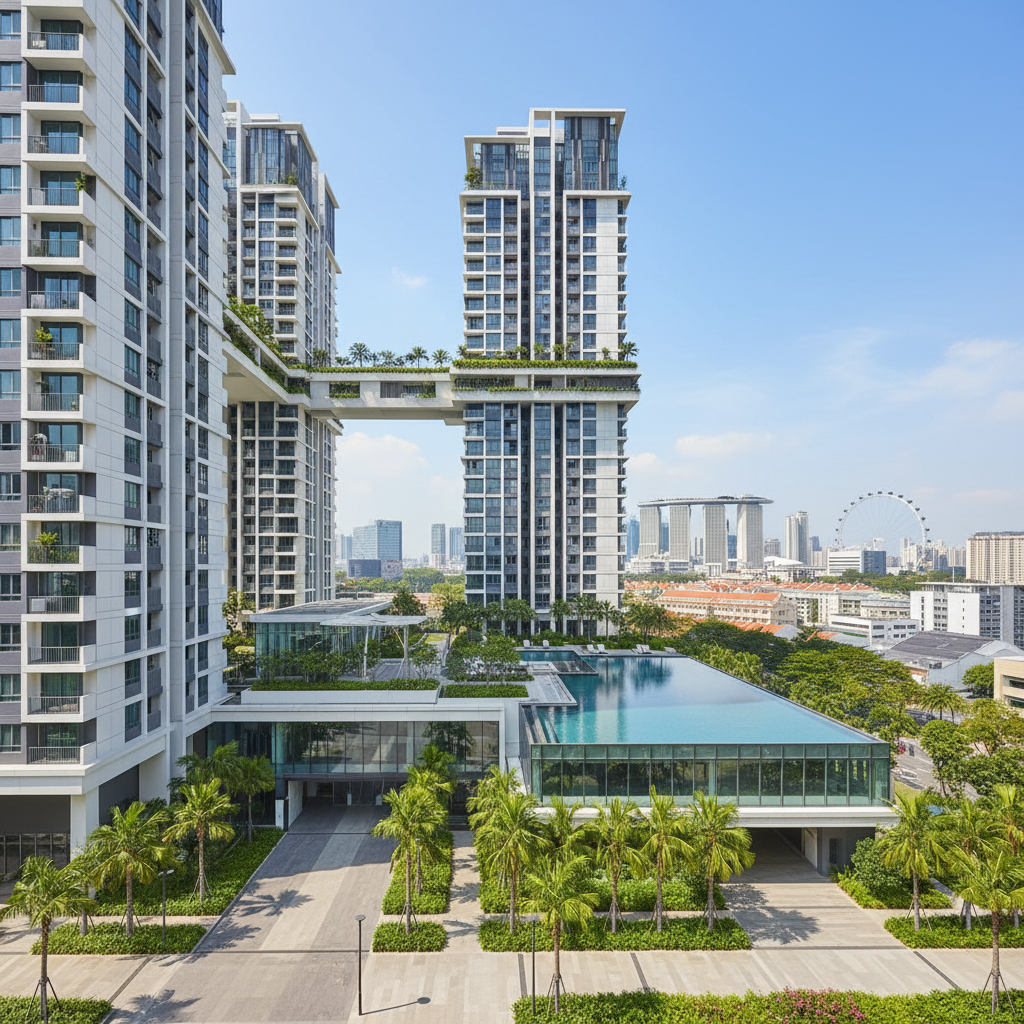
# Understanding Executive Condominiums in Singapore
Many people consider buying a home at some point. In Singapore, the housing market offers various choices. One unique housing type is the Executive Condominium, often called EC. Understanding what an EC is, how it works, and who can buy one is very important for potential homeowners. ECs bridge the gap between public housing, like HDB flats, and private condominiums. They offer characteristics of private properties but come with HDB eligibility rules and subsidies. This special blend makes them attractive to a specific group of Singaporeans. This article explains the key aspects of Executive Condominiums, including their regulations, benefits, and the journey from public to private housing. This information helps individuals make informed decisions about their property investments in Singapore.
## What Defines an Executive Condominium?
An Executive Condominium is a hybrid housing type in Singapore. It blends public and private housing features. The government introduced ECs in 1999 to cater to Singaporeans who earn too much to qualify for HDB flats but find private condominiums too expensive. ECs are built and sold by private developers. However, they follow specific rules set by the Housing & Development Board (HDB). This means buyers must meet certain eligibility criteria, similar to those for HDB flats.
For example, a typical EC project might have facilities like swimming pools, clubhouses, and gyms. These are common in private condominiums. However, the initial purchase price is usually lower than a fully private condo in a similar location. This lower price is partly due to the land being sold by the government to developers at a subsidised rate. Buyers also have access to HDB housing grants, which further reduces the financial burden. This dual nature means ECs offer a private living experience with public housing support.
A significant aspect of ECs is their liberalisation timeline. For the first five years after completion, an EC is considered a restricted property. Only eligible Singaporean citizens and Singapore Permanent Residents can buy it, and specific HDB rules apply to resales. After five years, it becomes a ‘privatised’ EC, meaning it can be resold to Singapore Permanent Residents, but still only to Singapore citizens. Only after ten years does an EC become fully privatised. At this point, it can be sold to foreigners and corporate entities, just like a private condominium, without HDB rules on buyer eligibility. This gradual liberalisation impacts its market value and resale potential greatly.
## Eligibility Criteria for Buying an EC
Buying an Executive Condominium involves meeting specific eligibility rules set by the HDB. These rules ensure that ECs serve their intended purpose: to help the “sandwich class” of Singaporeans. The primary buyer must be a Singapore Citizen. If buying with others, at least one other occupier must also be a Singapore Citizen or a Singapore Permanent Resident. This ensures that ECs primarily serve Singaporean families.
Here are the main eligibility conditions:
* **Citizenship:** At least one applicant must be a Singapore Citizen.
* **Family Nucleus:** You must form a proper family nucleus. This can be a married couple, fiancé and fiancée, parent(s) with child(ren), or an existing HDB flat owner and his or her family members. Single individuals are generally not eligible to buy a new EC directly from a developer, unless applying under specific schemes like the Joint Singles Scheme.
* **Age:** All applicants must be at least 21 years old. If buying under the Fiance/Fiancee Scheme, both must be at least 21.
* **Income Ceiling:** The combined average gross monthly household income must not exceed SGD 16,000. This ceiling helps ensure ECs are bought by their target demographic. This number can change, so checking the latest HDB regulations is always a good idea.
* **Property Ownership:** Applicants cannot own any other property, either locally or overseas. This includes private property or HDB flats. If an applicant currently owns an HDB flat, they must dispose of it within six months of receiving the keys to the EC. There are also restrictions on having owned other HDB properties previously. For example, you cannot have owned more than one HDB property or received more than one HDB housing grant in the past.
* **Minimum Occupation Period (MOP):** Owners of an EC must live in the property for a Minimum Occupation Period (MOP) of five years from the date of key collection. During this five-year period, the EC cannot be sold or rented out entirely. After the MOP, the owner can sell the EC.
These rules ensure that ECs are allocated to those who genuinely need them and meet the stipulated criteria. For example, a young married couple with a combined income of SGD 15,000 would typically qualify, provided they do not own other properties and meet the other conditions. Conversely, a single person earning SGD 20,000 would not meet the income or family nucleus requirements for a new EC purchase. These regulations maintain the integrity of the EC scheme.
## Benefits and Drawbacks of Buying an EC
Executive Condominiums offer a unique set of advantages that appeal to many Singaporean families, but they also come with certain limitations. Understanding both sides helps potential buyers make a balanced choice.
One major benefit is **affordability**. ECs are generally priced lower than private condominiums in comparable locations. This price difference arises because the government sells land for EC developments at discounted rates to private developers. Additionally, eligible first-time buyers can apply for HDB housing grants, such as the CPF Housing Grant, further reducing the upfront cost. For instance, a first-time married couple earning below a certain income threshold might receive up to SGD 30,000 in grants, making the purchase more accessible.
Another key advantage is the **condominium lifestyle**. ECs typically come with modern facilities such as swimming pools, gymnasiums, clubhouses, and security services. These amenities provide a comfortable and often luxurious living environment similar to private condos, but at a more palatable price point. Take for example, an EC development like North Gaia in Yishun. It offers units with good layouts and a wide array of facilities, appealing to families who want condo living without the full private condo price tag.
The **potential for appreciation** is also a significant draw. After the 5-year Minimum Occupation Period (MOP) and especially after the 10-year mark when it becomes fully privatised, an EC can see its value increase substantially. This is because the pool of potential buyers expands considerably – from only Singapore Citizens and PRs to include foreign buyers and corporate entities. This liberalisation often leads to a price jump, making ECs a good investment for many. For example, earlier ECs like Bishan’s Sky Habitat, which have long passed their 10-year mark, now fetch prices comparable to or even exceeding surrounding private condos.
However, ECs also have **drawbacks**. The primary one is the **HDB eligibility criteria**. These rules mean not everyone can buy a new EC. The income ceiling, family nucleus requirements, and property ownership restrictions limit who can enter the market. This also means a smaller pool of initial buyers when reselling within the first 10 years, potentially affecting resale value during that period.
The **MOP** itself is another restriction. For five years, owners cannot sell their EC or rent out the entire unit. This lack of flexibility can be an issue for those who might need to relocate or wish to upgrade quickly. Buyers must be committed to living in the unit for a sustained period. Additionally, the **location** of ECs can sometimes be a compromise. While some ECs are in well-developed areas, many are built in newer estates or further from central business districts. This is part of the government’s strategy to balance housing distribution and manage land costs. While public transport links often improve over time, initial connectivity might not be as as some private condos.
Balancing these pros and cons is crucial. For those who meet the eligibility and are prepared for the MOP, an EC can offer a valuable step onto the property ladder, combining comfortable living with investment potential.
## The Buying Process for an Executive Condominium
Purchasing an Executive Condominium in Singapore is a structured process that differs from buying a typical HDB flat or a private condo. Understanding these steps helps buyers prepare adequately.
The journey typically begins with checking **eligibility**. As discussed, you must meet criteria related to citizenship, family nucleus, income ceiling, and property ownership. This is the first and most critical step before even looking at developments. Many developers have online eligibility checkers or sales consultants who can assist with this initial assessment.
Next, you will need to **select a development and ballot for a unit**. When a new EC project is launched, interested buyers usually register their interest. Following this, there is an e-application period. During this period, applicants submit their documents and indicate their preferred unit types. Because demand often exceeds supply, especially for popular projects, balloting is used to determine who gets to choose units. This is similar to the HDB Build-To-Order (BTO) process. For instance, if an EC project in Singapore such as OLA in Sengkang launched with 548 units, thousands might register as interested, leading to a ballot to manage the selection process.
Once allocated a ballot number, you attend a **unit selection appointment**. Based on your ballot queue number, you will then choose an available unit. This is often a fast-paced environment, so having a few preferred choices ready is wise. After selecting a unit, you will sign the **Option to Purchase (OTP)**. This document reserves your unit for a period, typically 14 days. You will need to pay an option fee, usually 5% of the purchase price.
Within the option period, you must apply for an **HDB Loan Eligibility (HLE) letter** if you plan to take an HDB loan, or get an **approval-in-principle (AIP) from a bank** for a bank loan. This confirms your borrowing capacity. After sorting out financing, you proceed to **sign the Sale and Purchase Agreement**. This usually happens within eight weeks of the Option to Purchase date. At this point, you pay the remaining balance of the down payment, which is usually another 15%, bringing your total initial cash outlay to 20% (including the option fee).
The payment for an EC typically follows a progressive payment scheme. This means you pay instalments at different stages of the construction. For instance, you pay a percentage when the property structure is complete, another when the roof is added, and so on. The final payment is made upon completion and key collection. This systematic payment eases the financial strain compared to paying a large lump sum.
Finally, after the Temporary Occupation Permit (TOP) is granted and the project obtains its Certificate of Statutory Completion (CSC), you will be invited for **key collection**. This marks the point when you can take possession of your new EC unit. From this point, your 5-year Minimum Occupation Period (MOP) begins. The entire process, from application to key collection, can take several years, depending on the construction timeline of the EC project.
## Resale of Executive Condominiums and Market Trends
The resale market for Executive Condominiums follows a specific timeline and set of rules, which significantly impact their value and buyer pool. Understanding these regulations is crucial for both sellers and potential buyers.
As mentioned, an EC undergoes a **liberalisation process**. For the first five years after the Temporary Occupation Permit (TOP) date, the EC is subject to the **Minimum Occupation Period (MOP)**. During this time, the owner cannot sell the unit on the open market, nor can they rent out the entire unit. This period is strictly enforced to ensure ECs serve as owner-occupied homes. An example of an EC that recently cleared its MOP is Vista Residences in Sengkang, where units are now available for resale to eligible buyers.
After the 5-year MOP, an EC can be resold in the **secondary market**. However, at this stage, it can only be sold to **Singapore Citizens and Singapore Permanent Residents**. The HDB still applies its eligibility criteria to buyers, such as the family nucleus requirement and non-ownership of other private properties. This narrower buyer pool means that while there is an active resale market, it is not as broad as that for fully private condominiums.
The significant change happens after **10 years from the TOP date**. At this point, the EC becomes **fully privatised**. It means all HDB restrictions are lifted. The EC can then be sold to anyone, including single individuals, foreigners, and corporate entities, just like any other private condominium. This expansion of the buyer pool often leads to a **significant increase in market value**. Many original EC buyers aim to hold onto their units until this 10-year mark to maximise their investment returns. A well-known example of an EC that has fully privatised is The Quintet in Choa Chu Kang, where units now trade at prices comparable to or above surrounding private developments, attracting a wide range of buyers.
Market trends for ECs often reflect the broader property market, but with a unique twist due to their phased privatisation. Early MOP ECs still feel the pull of HDB regulations, impacting their immediate resale prices. However, fully privatised ECs tend to behave more like private condos. Factors such as proximity to MRT stations, reputable schools, and amenities heavily influence prices. The supply of new ECs also plays a role. When new EC launches are popular, it can sometimes affect the demand for resale ECs, especially those nearing their MOP.
Case study: Prive EC in Punggol was one of the first EC projects launched under the revised income ceiling framework. After its MOP, units saw healthy appreciation. As it approaches its 10-year mark, its resale prices are expected to rise further, as it transitions into a fully private property. This trajectory provides a clear example of the investment potential inherent in the EC model.
Considering an EC for resale requires understanding these timelines and the changing buyer demographics. For a seller, patience until the 10-year mark can yield greater profits. For a buyer looking at a resale EC, knowing where it stands in its liberalisation journey
### Let’s Talk About Your Property Goals
Whether you’re looking to buy, sell, or invest, we’re here to help. WhatsApp us to book a consultation or explore opportunities with Zaidean.