
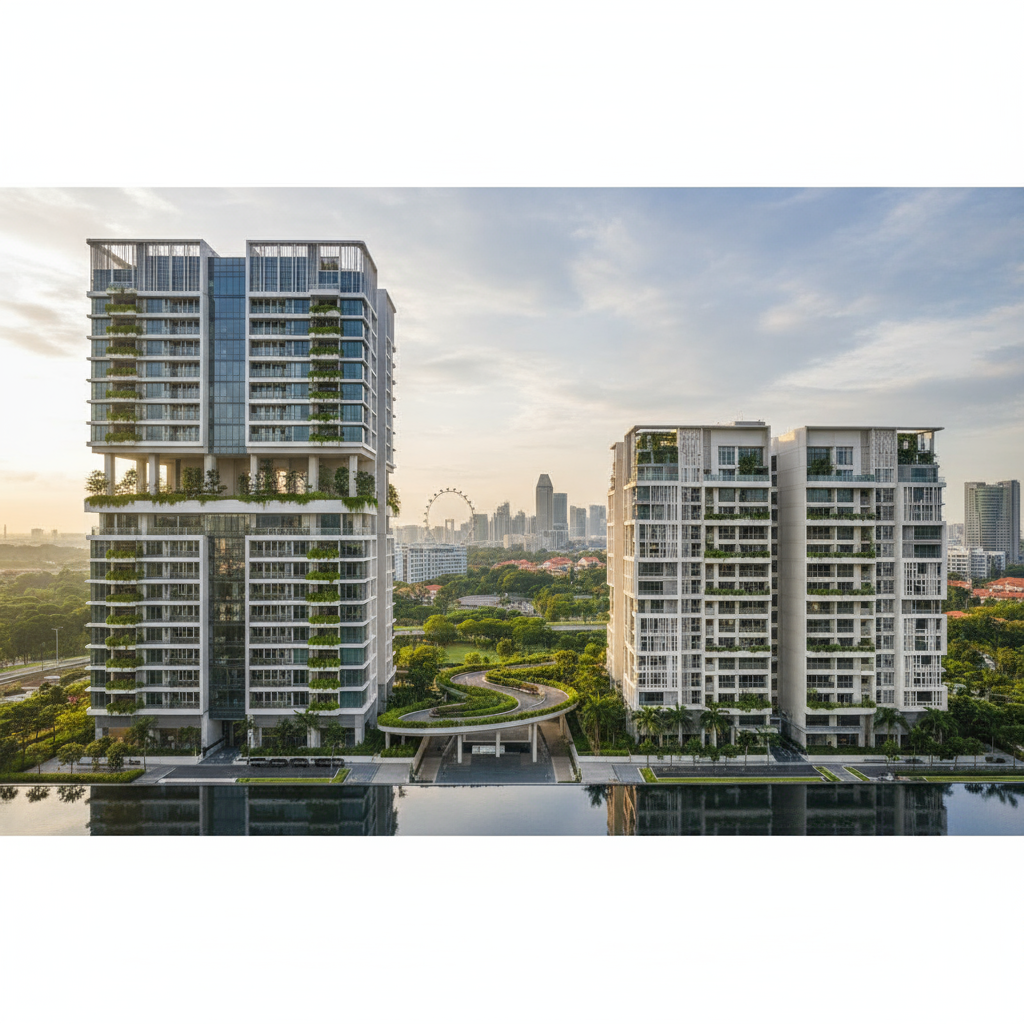
Executive Condominium vs. Private Condominium: Making the Right Property Choice in Singapore
Deciding between an Executive Condominium (EC) and a private condominium is a significant decision for many Singaporean property buyers. Both offer attractive living options, but they cater to different buyer profiles and come with distinct rules and benefits. Understanding these differences is crucial for making an informed choice that aligns with your financial situation and lifestyle goals. This guide will explain the key characteristics of ECs and private condominiums, helping you weigh the pros and cons of each. We will look at eligibility criteria, ownership rules, financing options, and the potential for capital appreciation, all within the context of Singapore’s unique property market.
For first-time buyers, young families, or those upgrading from HDB flats, the choice between an EC and a private condominium often comes down to budget, long-term plans, and eligibility. ECs are a hybrid housing type, a public-private housing solution designed to bridge the gap between HDB flats and private condominiums. They offer condominium-style facilities at a more affordable price, but with certain restrictions. Private condominiums, on the other hand, provide full private ownership from the start, offering more flexibility but typically at a higher cost. By the end of this article, you will have a clear picture of which property type might be a better fit for your property journey in Singapore.
Understanding Executive Condominiums (ECs) in Singapore
Executive Condominiums (ECs) are a unique housing option in Singapore, created to help middle-income Singaporeans afford private-style living. They are developed and sold by private developers but come with HDB eligibility and ownership rules for the first ten years. This hybrid nature means they offer a stepping stone for those who aspire to private property but might find private condominiums too expensive initially.
ECs provide a range of facilities similar to private condominiums, such as swimming pools, gyms, clubhouses, and security services. Examples of popular EC projects include North Gaia in Yishun, Tenet in Tampines, and Copen Grand in Tengah. These developments often feature modern designs and spacious layouts, appealing to families looking for a comfortable living environment.
A key benefit of buying an EC is the potential for government grants. Eligible first-time buyers, especially those upgrading from HDB flats, can apply for grants like the CPF Housing Grant, which can significantly reduce the purchase price. This makes ECs a more accessible option for many Singaporeans. For instance, a family earning a combined income of up to S$16,000 per month might qualify for an EC, whereas the income ceiling for HDB BTO flats is S$14,000.
However, ECs come with strict eligibility criteria. Buyers must be Singapore citizens, meet income ceilings, and not own other private property. There is also a Minimum Occupation Period (MOP) of five years, during which the EC cannot be sold or rented out entirely. After five years, the EC can be sold to Singapore citizens or Permanent Residents (PRs). Only after ten years from the Temporary Occupation Permit (TOP) date does the EC become fully privatised, meaning it can be sold to foreigners. This phased privatisation affects resale value and the pool of potential buyers at different stages.
Exploring Private Condominiums in Singapore
Private condominiums represent full private property ownership in Singapore. They are developed by private developers and are not subject to HDB’s eligibility criteria or ownership restrictions. This offers greater flexibility in terms of buying, selling, and renting. Private condominiums cater to a wider range of buyers, including Singapore citizens, Permanent Residents, and foreigners, provided they meet financial requirements.
Private condominiums typically boast a comprehensive array of facilities, often more extensive and luxurious than those found in ECs. These can include multiple swimming pools, tennis courts, BBQ pits, function rooms, and sometimes even concierge services. Popular private condominium projects like The Avenir in River Valley, CanningHill Piers in Clarke Quay, and Lentor Modern in Lentor offer prime locations, high-end finishes, and a premium lifestyle.
One significant advantage of private condominiums is the immediate freedom to sell or rent out the property without any occupation period restrictions. This flexibility is attractive to investors or those who anticipate needing to relocate in the future. For example, an investor might purchase a private condominium with the intention of renting it out immediately to generate rental income, which is not possible with an EC during its MOP.
Financing a private condominium generally involves a larger down payment and higher loan amounts compared to ECs. Buyers do not qualify for government grants when purchasing a private condominium. However, they have more choices in terms of banks and loan packages. The stamp duties, such as Buyer’s Stamp Duty (BSD) and Additional Buyer’s Stamp Duty (ABSD), apply to private condominiums, and the ABSD rates can be substantial for second properties or foreign buyers. For instance, a Singapore citizen buying a second residential property would pay 20% ABSD on the purchase price.
Key Differences: Eligibility, Ownership, and Financing
The distinctions between ECs and private condominiums are most apparent in their eligibility rules, ownership restrictions, and financing structures. These factors directly influence who can buy each type of property and how they can manage their investment.
Eligibility Criteria:
* Executive Condominiums (ECs):
* Buyers must be Singapore citizens.
* Must form a family nucleus (e.g., married couple, parent with child).
* Gross monthly household income ceiling of S$16,000.
* Cannot own other private property, either locally or overseas.
* First-time buyers may be eligible for CPF Housing Grants.
* Private Condominiums:
* Open to Singapore citizens, Permanent Residents (PRs), and foreigners.
* No income ceiling.
* No restrictions on owning other properties, though Additional Buyer’s Stamp Duty (ABSD) applies for subsequent properties.
* No government grants available.
Ownership and Resale Restrictions:
* Executive Condominiums (ECs):
* Minimum Occupation Period (MOP): Five years from the date of TOP. During MOP, the EC cannot be sold or rented out entirely.
* After 5 years (post-MOP): Can be sold to Singapore citizens or Permanent Residents.
* After 10 years (fully privatised): Can be sold to anyone, including foreigners. This full privatisation often leads to a significant increase in market value.
* Private Condominiums:
* No MOP or ownership restrictions.
* Can be sold or rented out at any time after purchase.
* Can be sold to Singapore citizens, PRs, and foreigners immediately.
Financing and Grants:
* Executive Condominiums (ECs):
* Can apply for CPF Housing Grants (e.g., Family Grant, Proximity Housing Grant) for eligible first-time buyers, effectively lowering the purchase price.
* Loan-to-Value (LTV) limits apply, with a maximum of 75% for the first housing loan.
* Stamp duties (Buyer’s Stamp Duty) apply.
* Private Condominiums:
* No government grants available.
* LTV limits apply, similar to ECs, with a maximum of 75% for the first housing loan.
* Stamp duties (Buyer’s Stamp Duty) and Additional Buyer’s Stamp Duty (ABSD) apply, with ABSD rates varying based on citizenship and number of properties owned. For example, a Singapore citizen buying their second property will pay 20% ABSD.
Understanding these fundamental differences is crucial for prospective buyers. An EC offers a more affordable entry point into private-style living with government support, but at the cost of immediate flexibility. A private condominium offers full flexibility and wider market appeal but comes with a higher price tag and no grant assistance.
Capital Appreciation and Investment Potential
When evaluating ECs versus private condominiums, potential for capital appreciation is a key consideration for many buyers. Both property types can offer good returns, but their appreciation trajectories and market dynamics differ due to their unique characteristics and regulations.
Executive Condominiums (ECs):
ECs often show strong capital appreciation, particularly after the Minimum Occupation Period (MOP) and especially after full privatisation at the ten-year mark.
* Post-MOP Appreciation: Once the MOP is over (after five years), ECs can be sold to Singapore citizens and PRs. This opens up the buyer pool significantly compared to the initial market for new ECs. This increased demand often leads to a jump in prices. For example, an EC project like Bellewoods in Woodlands, which obtained TOP in 2017, saw average resale prices increase substantially from its launch price after its MOP ended in 2022.
* Full Privatisation (10-year mark): The most significant price appreciation often occurs when an EC becomes fully privatised after ten years. At this point, it is treated exactly like a private condominium, and foreigners can purchase it. This expands the buyer pool even further, often resulting in a substantial price increase as the property now commands private condominium prices. For instance, projects like Bishan Loft, an older EC, have seen their prices reach parity with, or even surpass, surrounding private condominiums after full privatisation.
* Government Support: The initial subsidies and grants for ECs contribute to their affordability, which can translate to a higher percentage gain on the initial investment when they are eventually sold on the open market.
Private Condominiums:
Private condominiums generally have a more immediate and consistent appreciation potential, driven by market forces, location, and property attributes.
* Market Demand: Private condominiums are directly influenced by the broader private property market, economic conditions, and interest rates. Strong demand, especially for well-located or premium projects, can lead to steady price growth.
* Location and Amenities: Properties in prime districts, near MRT stations, or with reputable schools nearby often command higher prices and appreciate more reliably. For example, condominiums in areas like Orchard, Marina Bay, or those with immediate access to major transport hubs tend to hold their value well and appreciate consistently.
* Immediate Flexibility: The lack of an MOP for private condominiums means owners can capitalise on favourable market conditions at any time. This flexibility can be an advantage for investors who want to buy and sell based on shorter-term market cycles.
* Broader Buyer Pool: From day one, private condominiums are open to all buyers (Singapore citizens, PRs, and foreigners), ensuring a wider market for resale.
Investment Considerations:
* Entry Price: ECs offer a lower entry price point for a private-style property, which can mean a higher percentage return on initial capital if appreciation is strong.
* Liquidity: Private condominiums generally offer better liquidity due to the wider buyer pool and absence of selling restrictions. ECs have limited liquidity during the MOP.
* Risk: While ECs offer potential for strong appreciation after privatisation, their value during the MOP is more constrained due to selling restrictions. Private condominiums are more subject to general market fluctuations.
Buyers should consider their investment horizon and risk tolerance. If you are prepared to hold a property for at least ten years, an EC can offer significant upside. If you prefer immediate flexibility and a broader market, a private condominium might be more suitable.
Practical Tips for Buyers: EC vs. Private Condo
Choosing between an EC and a private condominium requires careful thought and a clear understanding of your personal circumstances. Here are some practical tips to help you make the right decision.
* For ECs: First, check if you meet the HDB eligibility criteria, including income ceilings and family nucleus requirements. Use the HDB website or consult a property agent to confirm your eligibility. Calculate your maximum loan amount and potential CPF grants. Remember the income ceiling for ECs is S$16,000.
* For Private Condos: If you do not meet EC eligibility or prefer more flexibility, private condominiums are your option. Ensure you have sufficient funds for a larger down payment and factor in additional costs like stamp duties (including ABSD if applicable).
* Long-Term (10+ years) and Family-Oriented: If you plan to live in the property for a long time (at least 10 years to reach full privatisation) and prioritise a family-friendly environment with condominium facilities at a lower entry price, an EC could be ideal. Consider ECs in developing estates like Tengah or Sengkang, which offer good growth potential.
* Short-Term Flexibility or Investment-Focused: If you need the option to sell or rent out your property quickly, or if you are an investor looking for immediate rental income, a private condominium is a better fit. Look at properties in established areas with good rental demand, such as those near business districts or universities.
* For both ECs and Private Condos: Location is paramount. Research upcoming infrastructure projects like new MRT lines, schools, and commercial hubs. These developments can significantly boost property values. For example, a condominium near the upcoming Thomson-East Coast Line stations might see better appreciation.
* EC-Specific: ECs are often built in developing non-mature estates. While this offers lower entry prices, consider the current amenities and your comfort level with waiting for the estate to fully mature.
* Purchase Price: ECs generally have lower per-square-foot prices than private condominiums in comparable locations.
* Down Payment: Be prepared for a larger down payment for private condominiums.
* Stamp Duties: Calculate Buyer’s Stamp Duty (BSD) for both. For private condominiums, also account for Additional Buyer’s Stamp Duty (ABSD) if you are a PR, a foreigner, or a Singapore citizen buying a second or subsequent property.
* Maintenance Fees: Both property types have monthly maintenance fees, which vary by project and facility offerings.
* Legal Fees and Other Charges: Do not forget legal fees, valuation fees, and home loan processing fees.
* Property Agents: Engage a reputable property agent who specialises in both ECs and private condominiums. They can provide market insights, help you identify suitable projects, and guide you through the buying process.
* Bankers/Mortgage Brokers: Speak to multiple banks or a mortgage broker to understand your loan eligibility and compare interest rates and loan packages for both ECs and private condominiums. This will help you secure the best financing terms.
By carefully considering these tips and evaluating your personal situation, you can make a well-informed decision that aligns with your property goals in Singapore.
Let’s Talk About Your Property Goals
Whether you’re looking to buy, sell, or invest, we’re here to help. WhatsApp us to book a consultation or explore opportunities with Zaidean.